
As the temperature climbs across Victoria, Melbourne gardens become a hive of activity. While the sound of buzzing insects is a natural part of a Melbourne summer, it can also be a source of significant anxiety for homeowners. Whether you are hosting a BBQ in the eastern suburbs or enjoying the breeze on a coastal deck, distinguishing between a harmless pollinator and a dangerous pest is vital for your family’s safety.
Misidentification is one of the biggest hurdles in effective pest control in Melbourne. Many residents mistake aggressive European Wasps for common Honey Bees, or panic over solitary Mud Daubers that pose little threat. This handbook is designed to provide clarity, helping you identify exactly what is buzzing around your property and when it is time to call in professional wasp control in Melbourne.
The “Hornet” Myth: What is Really Buzzing in Victoria?
In many parts of the world, “hornets” are the primary concern for homeowners. However, it is a common misconception in Victoria that we have true hornets. Biologically speaking, there are no true hornets (Vespa genus) established in Australia.
When Melburnians report “hornets,” they are usually seeing a particularly large European Wasp or a native solitary wasp like the Cicada Killer. While the name doesn’t change the fact that a large, stinging insect is present, understanding that we are dealing with wasps—not hornets—is the first step in applying the correct treatment protocol. True hornets are generally larger, but the European Wasp is more than aggressive enough to require professional intervention.
European Wasp: Melbourne’s Primary Summer Threat
The European Wasp (Vespula germanica) is the most significant reason residents seek wasp control in Melbourne. This introduced species thrives in the Victorian climate. Because our winters are relatively mild, some colonies don’t die off as they do in Europe, leading to “super-nests” that can house tens of thousands of wasps.
European Wasps are identified by their bright yellow and black banded bodies and black antennae. They are roughly the size of a honey bee but are smooth rather than “fuzzy.” They are notorious for their aggression; they can sting multiple times without dying and will actively defend their nest if they perceive a threat within a several-metre radius.
Australian Paper Wasps: The Slender Gardeners
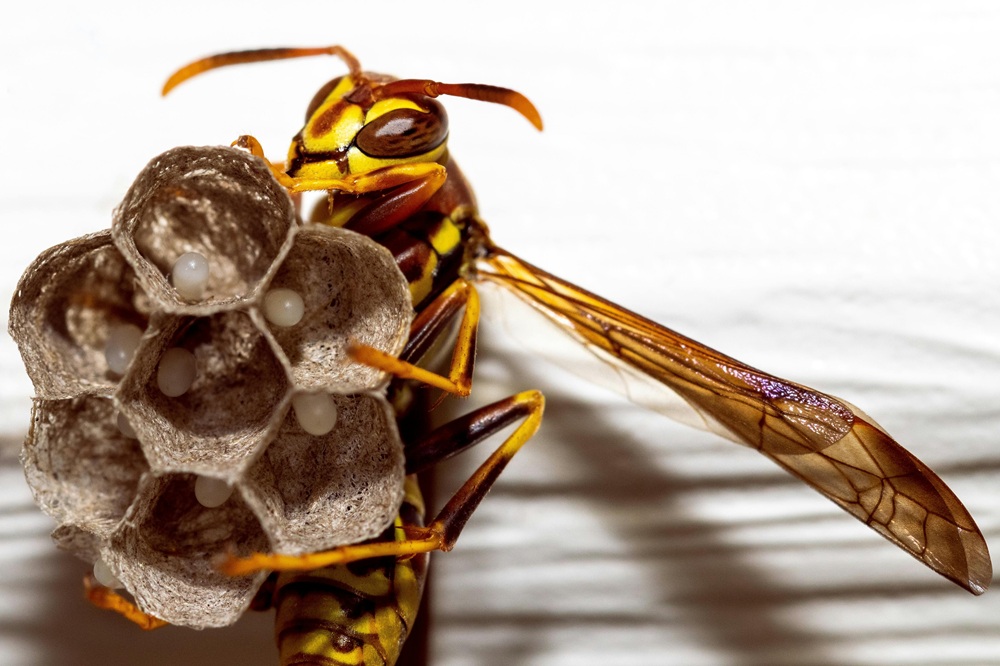
If you notice a small, honeycomb-like nest hanging from your eaves, fence, or a sturdy branch, you are likely looking at the Australian Paper Wasp. These wasps are longer and more slender than the European variety and are usually a reddish-brown or tan colour with yellow markings.
Their nests are shaped like an inverted umbrella with open, visible cells. While Paper Wasps will sting if their nest is disturbed, they are generally less aggressive than their European cousins. However, because they often build nests near high-traffic areas like doorways, they frequently require professional removal to ensure the safety of residents and pets.
Honey Bees vs. Wasps: Know the Difference
At the heart of responsible pest control in Melbourne is the protection of our beneficial pollinators. Honey Bees (Apis mellifera) are essential for our ecosystem. They are easily distinguished by their golden-brown colour and hairy, “fluffy” bodies.
Honey Bees are generally non-aggressive unless their hive is directly threatened. Because their populations are under pressure, our policy is to recommend relocation by a professional bee control company.
Solitary Wasps: Mud Daubers and Potters
Have you ever found hard, mud-covered tubes on your brickwork or inside your garage? These are the work of Mud Dauber or Potter Wasps. These wasps are often very large and can look intimidating with their extremely thin “waists” and long bodies.
Despite their appearance, they are solitary and not aggressive. The female builds the mud nest, stocks it with paralysed spiders for her larvae, and then leaves. They do not “guard” their nests like social wasps. While the mud nests can be unsightly, these wasps pose very little risk to humans and are actually quite helpful at keeping spider populations in check.
Identifying the Nest: Location-Based Clues
The location of a nest is often the biggest clue to the species involved. Understanding these patterns is a key part of effective wasp control in Melbourne:
- Underground: If you see wasps flying in and out of a hole in the lawn, it is almost certainly a European Wasp nest.
- Wall Cavities and Roof Voids: European Wasps love the protection of your home’s structure. You may see them entering through a weep hole or under a roof tile.
- Exposed Eaves and Fences: Paper Wasps prefer these open, airy locations.
- Hollow Trees: Honey Bees frequently choose hollowed-out trunks for their hives.
Danger of DIY: Why Supermarket Sprays Fail?
Many people ask why they can’t just spray a nest with a garden hose or a bottle of supermarket insecticide. The answer lies in the sheer scale of the nests. A European Wasp nest can be the size of a basketball and contain thousands of individuals.
Retail wasp sprays are often “contact kills” only. This means they kill the wasps they touch directly but do nothing to the thousands hidden inside the nest. Even worse, many of these sprays act as irritants. If you spray the entrance of a nest, you are essentially “knocking on the door” and inviting the colony out to defend their home. In a suburban Melbourne setting, this can lead to neighbours or passers-by being stung.
Aggression and Pheromones: The “Swarm” Response
What makes European Wasps particularly dangerous is their use of alarm pheromones. When a wasp is threatened or crushed, it releases a chemical signal that alerts every other wasp in the vicinity to attack.
This is why “swatting” at a wasp near a nest is a terrible idea. Within seconds, a single wasp can turn into a swarm. Professional wasp nest removal in Melbourne involves neutralising the nest quickly using specialised dusts and foams that don’t trigger this “frenzy” response, ensuring the safety of the technician and the family.
Sting Risks and First Aid
A wasp or bee sting is a minor irritation for some but a life-threatening event for those with allergies. It is estimated that up to 3% of the Australian population may be at risk of anaphylaxis from insect stings.
For a standard sting, the area should be washed with soap and water, and a cold pack applied to reduce swelling. However, if the victim experiences difficulty breathing, swelling of the tongue, or a sudden drop in blood pressure, call for medical assistance immediately. Because European Wasps often nest in suburban backyards, knowing the location of your nearest hospital is essential for Melbourne families during summer.
The Professional Advantage: Safety and Expertise
Professional pest controllers have the necessary personal protective equipment (PPE), including full-body wasp suits, to stand ground against an angry colony. We also use high-pressure dusting equipment that can penetrate deep into wall cavities or underground tunnels, reaching the queen. Without eliminating the queen, the nest will simply rebuild.
Furthermore, using a licensed and insured provider ensures that the treatment is effective and that the liability for any accidents is managed professionally.
Seasonal Maintenance: Protecting Your Property
While January and February are the peak months, wasp control in Melbourne is a year-round consideration. During autumn, new queens leave the nest to find a place to hibernate.
By sealing gaps in your eaves and installing fine mesh over weep holes, you can prevent queens from setting up shop in your home next spring. Additionally, keeping fallen fruit cleared from under trees and ensuring your outdoor bins have tight-fitting lids will make your property much less attractive to foraging wasps during the summer months.
Take Back Your Backyard Today
The sound of summer should be relaxing, not a source of anxiety. With our newly redesigned website, you can now access detailed species guides and high-resolution imagery to help you identify exactly what is buzzing around your home. If you suspect you have a European Wasp nest or a dangerous accumulation of Paper Wasps, don’t wait for a sting to occur.
If you have found a nest in a high-traffic area or have a wasp emergency, our team is standing by to provide immediate assistance. Call us now on 1300 997 272 to speak with a local expert and schedule your professional wasp control in Melbourne.