
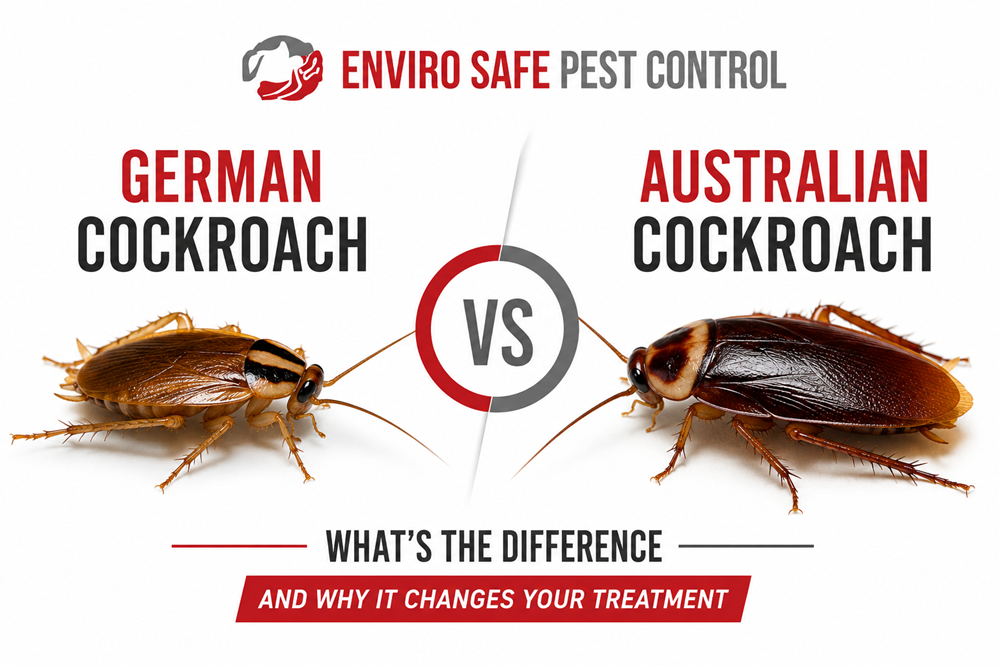
When homeowners call about a cockroach problem, the first question our technicians ask is: which species are you dealing with? It is not a trivial detail. Effective cockroach control in Melbourne depends almost entirely on getting that identification right. The two most commonly confused species — the German cockroach and the Australian cockroach — look similar enough to fool most people at a glance, yet they live in completely different parts of your home, breed at vastly different rates, and require entirely different treatment approaches. Use the wrong method and you will reduce the visible population for a week or two, then wonder why they are back in full force a month later.
This guide breaks down exactly how to tell these two species apart, why their differences matter so much for treatment, and what a professional service actually does differently for each one.
How to Tell Them Apart
Size is the fastest starting point. The German cockroach is small — typically 12 to 16 mm in length — with a light tan to medium brown body and two distinct dark stripes running lengthways down its back. It has wings but almost never flies. The Australian cockroach is considerably larger at 23 to 35 mm, reddish-brown in colour, and has a distinctive pale yellow stripe along the outer edges of its forewings and a yellow marking around the head. It can fly and is drawn to light, which is why Melbourne homeowners often find them near doors, windows, and outdoor lights on warm evenings.
Habitat is equally telling. If you find a small, pale cockroach behind your refrigerator or inside a kitchen cabinet at night, it is almost certainly a German cockroach. If a large, reddish-brown roach flies in through an open door or crawls up from a drain, it is almost certainly an Australian cockroach. Getting this distinction right before any treatment begins is the difference between a lasting result and a recurring infestation.
The German Cockroach: Small, Fast, and Strictly Indoors
Despite its name, the German cockroach did not originate in Germany. It is thought to have come from tropical Africa and has since established itself in homes, restaurants, and apartment buildings across every continent. In Melbourne, it is responsible for the most severe residential infestations and the highest rate of treatment failures — largely because it is so frequently misidentified or underestimated.
Why it spreads so quickly
The German cockroach is a strictly indoor pest. It does not enter from the garden — it arrives as a stowaway, hidden inside cardboard grocery boxes, second-hand appliances, or food delivery packaging. Once inside, it breeds at an alarming rate. A single female produces an egg case carrying up to 40 eggs, and the colony can cycle through three to four breeding generations in a single year. From egg to breeding adult takes as little as 40 days. By the time a cockroach is spotted during daylight hours — a sign of severe overcrowding — hundreds more are concealed in harborage sites throughout the property.
Where it hides
German cockroaches spend the vast majority of their time in warm, humid, undisturbed spaces. They concentrate behind and beneath refrigerators, dishwashers, and ovens, inside cabinetry hinges and drawer runners, around the motor housing of microwaves and coffee machines, in bathroom vanity units where hot pipes create humid microclimates, and within wall voids adjacent to kitchen plumbing. Adults travel only one to two metres from their harborage, which means an infestation can remain tightly concentrated in one area for a long time before spreading.
Why surface sprays fail
German cockroaches spend up to 75 percent of their time inside harborage sites that a surface spray cannot reach. Spraying an exposed cockroach kills that individual but leaves the colony entirely untouched. Worse, pyrethroid sprays can trigger a stress response that causes the colony to scatter and relocate to other parts of the property, making the infestation harder to treat. This is one of the primary reasons DIY attempts so consistently fail against this species.
The correct treatment approach
Professional treatment for German cockroaches relies on targeted gel bait placed precisely inside harborage points — behind appliances, along drawer tracks, inside cabinetry. The cockroach consumes the bait and returns to the nest, where the active ingredient spreads through contact and cannibalism, collapsing the colony from within. Crack-and-crevice insecticide application and insect growth regulators (IGR), which sterilise surviving females and prevent nymphs from maturing, are also part of an effective program. A single treatment visit is rarely enough for an established German cockroach infestation — structured follow-up is essential.
The Australian Cockroach: Large, Seasonal, and Coming From Outside
The Australian cockroach, despite its name, most likely originated in Africa and arrived in Australia via cargo ships. It is the species homeowners are more likely to encounter outdoors, and it tends to enter homes opportunistically rather than establishing a breeding population indoors from the outset. At 23 to 35 mm, it is significantly larger and more visually striking than its German counterpart — and while it may cause alarm, it is generally a less complex infestation to resolve when treated correctly.
Where it lives and how it enters
Australian cockroaches are primarily outdoor insects. They thrive in leaf litter, mulch beds, woodpiles, and garden debris. Around Melbourne homes, they commonly inhabit subfloor voids and roof spaces in older properties, drains and downpipes, the areas around compost bins, and damp corners of sheds and garages. They enter homes through open doors and windows at night — attracted to interior lighting — as well as through subfloor vents, poorly sealed drains, and gaps around external pipes and cables. Activity peaks during Melbourne’s warmer and more humid months, which is why many homeowners notice a clear seasonal surge from late spring through summer.
Health and damage risks
Although the Australian cockroach breeds less aggressively indoors than the German variety, it is not a harmless visitor. It carries bacteria and pathogens between outdoor environments — drains, compost, garden debris — and the food preparation surfaces inside your home. It also chews through stored paper goods, clothing, and books, and can damage seedlings and indoor plants when populations are high. In commercial settings, even occasional sightings of Australian cockroaches can present hygiene compliance issues.
The correct treatment approach
Because the Australian cockroach lives and breeds primarily outdoors, effective treatment targets the property perimeter and known entry points rather than interior surfaces. A licensed technician applies residual barrier spray to external walls, window and door frames, weep holes, and garden bed edges, creating a protective zone the cockroach must pass through before entering. Subfloor and roof void dusting addresses any existing internal populations. Drain treatment and practical habitat advice — reducing mulch depth close to the house, relocating woodpiles, fixing dripping taps — are important elements of preventing the infestation from returning season after season.
Why Getting the Species Wrong Costs You Time and Money
Using a German cockroach treatment strategy against an Australian cockroach problem — or vice versa — is one of the most consistent reasons homeowners experience repeated treatment failures. Gel bait placed for German cockroaches is ignored by Australian cockroaches, which forage outdoors and have no reason to approach an indoor bait station. Perimeter spray applied for Australian cockroaches does not penetrate the harborage sites where a German cockroach colony is actively breeding. DIY products that target adult cockroaches only leave eggs and nymphs completely unaffected, and the colony repopulates within weeks.
Research indicates that homeowners correctly identify cockroach species only around 43 percent of the time without professional guidance. Licensed pest control technicians achieve species identification accuracy of over 94 percent. That gap directly determines treatment outcomes. Correct identification is not a preliminary step — it is the foundation the entire treatment plan is built on.
What to Do If You Spot a Cockroach in Your Melbourne Home
- Do not spray it with a surface aerosol — this scatters the colony and makes treatment harder
- Note the size, colour, and location — even a rough description helps with species identification
- Check for secondary signs: egg cases, dark pepper-like droppings, or a musty odour inside cabinets
- Avoid cleaning or disturbing suspected harborage areas before a technician visits
- Call a licensed professional — species identification must come before any product is applied
Not sure which cockroach you’re dealing with?
Whether you are dealing with a German cockroach outbreak in a Melbourne apartment kitchen or an Australian cockroach surge around an older home’s subfloor and garden, the answer is always the same — identify first, treat second. At Enviro Safe Pest Control, our licensed technicians have been delivering targeted, species-specific pest control in Melbourne since 2013. We use eco-friendly, family-safe products, provide a detailed written report after every service, and back every job with a 100% satisfaction guarantee. Don’t waste money on repeat treatments that miss the root cause. Call Enviro Safe Pest Control today on 1300 997 272 and get it resolved properly — first time.
Ready to get rid of cockroaches for good?
Enviro Safe Pest Control — Melbourne’s trusted, eco-friendly pest specialists since 2013.
Call 1300 997 272
Licensed | Eco-Friendly | 100% Satisfaction Guarantee | Same-Day Appointments Available